Interview · Politics, media and digital culture
Reclaiming the web: Massimo Scognamiglio on Lavagna.
The artist and web pioneer discusses Lavagna., the web’s passage from emancipation to control, and how Hikikomori and the Rooms expose the politics of isolation.
Why is Lavagna. a political project?
Because the decisive question today is not only what we watch, but who organises our gaze. Large platforms do more than distribute content: they order time, rank priorities, measure hesitation and turn attention into economic value. Lavagna. rejects the idea that this architecture is inevitable.
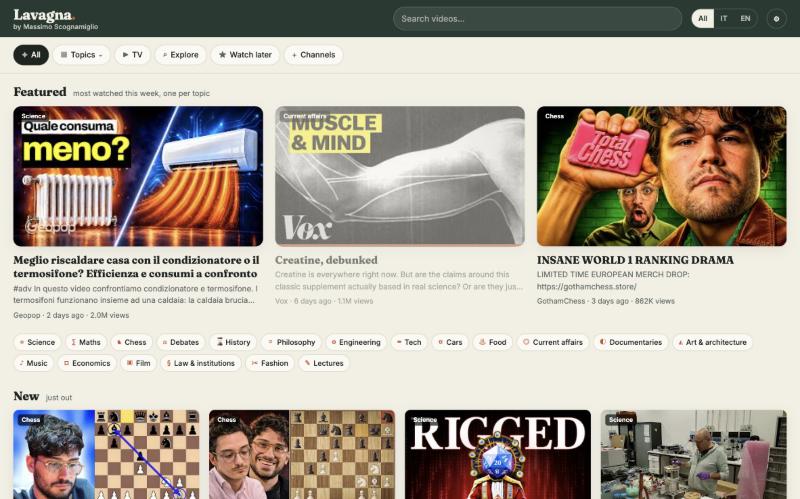
It is a small, concrete gesture: a human selection of long-form videos, organised by subject, without an infinite feed, Shorts, or advertising and tracking added by the page. It does not claim to replace the internet. It proves that we can still build different doors into it.
Wasn’t the web already a promise of freedom?
It was, and partly still is. The early web allowed people to publish, learn, meet and build spaces with modest means. It was neither innocent nor perfectly democratic, but it carried an emancipatory force: millions could move from audience to authorship.
That freedom was gradually fenced in. Speculation turned relationships, images and knowledge into extractable material. The dominant model profiles us, predicts behaviour, rewards whatever holds us longest and hides the criteria by which the world is shown. A tool of liberation can thus become a tool of control.
Does reclaiming media mean nostalgia?
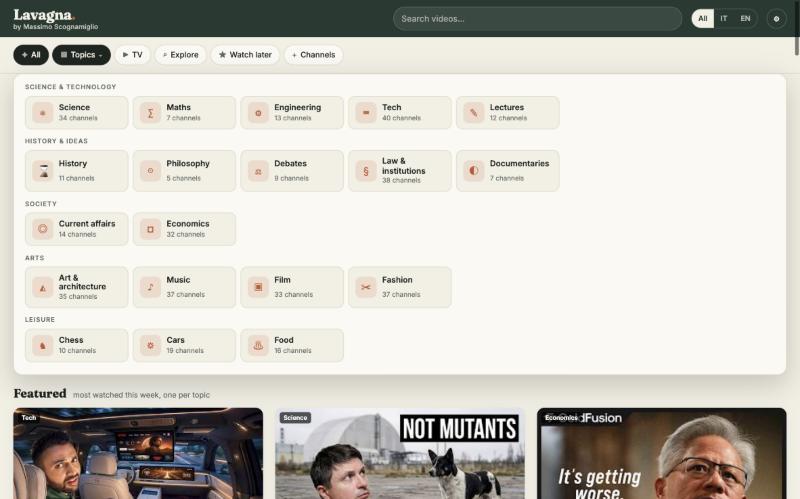
No. Nostalgia invents a golden age that never existed. Reclaiming media means using current technology for different ends: reducing the capture of attention, making curation visible, giving users a beginning and an end, and restoring the right to stop.
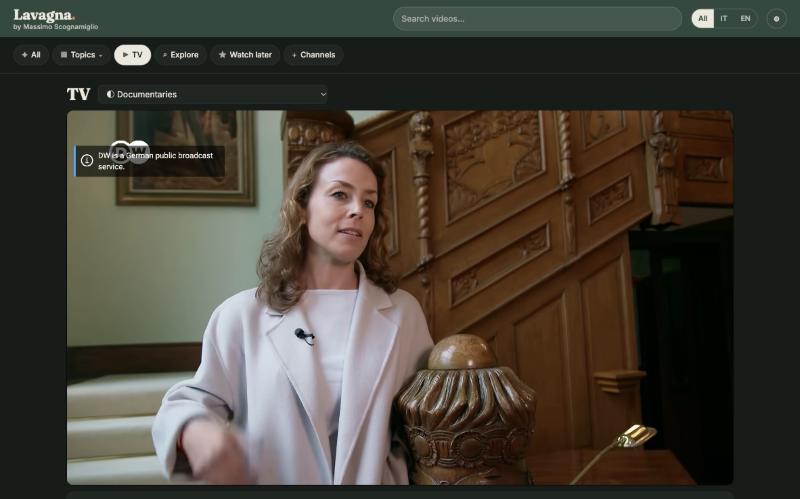
Lavagna. also uses YouTube, but refuses to treat its automatic corridor as the only possible form. It behaves like a library rather than a casino: shelves, finite choices and paths that do not pursue addiction.
Why remove the algorithm?
I am not against algorithms as such. Every index orders and every curator chooses. The problem begins when the criterion is secret, optimised for profit and presented as natural. Selection then ceases to be debatable and becomes the environment itself.
Lavagna. restores editorial responsibility. Channels are chosen by a person; the list is visible, limited and correctable. You can disagree, suggest a channel or copy the project. The possibility of contesting the criterion is already a political difference.
Human curation can also become authority. How do you address that risk?
Not by claiming neutrality, but by making the device readable. The curation is declared, its boundaries are visible and the code is open. I am not saying: this is what everyone must see. I am saying: here is a proposal that can be checked, changed and replicated.
Open source prevents selection from becoming a proprietary enclosure. Anyone can study the code, alter it and create another Lavagna. with different criteria. Plurality comes from the practical ability to build many spaces, not from an algorithm pretending to know us.
How does Lavagna. relate to Hikikomori?
Hikikomori stages a contemporary contradiction: the screen promises connection and can become a wall. Its rooms do not judge withdrawal; they show how fragile the border is between shelter and prison. Technology can preserve contact with the world, but it can also administer isolation and make it profitable.
Lavagna. tries to reverse that relationship. It does not want to occupy every minute or know the user better than they know themselves. It tries to reopen the screen: not a wall that holds you, but a window you can also walk away from.
And the Rooms? Why do they return in a discussion of digital politics?
A room is always a political architecture. It decides what enters, what remains outside, who can see and who can be seen. In my work the room is protection, solitude and control at once. An interface is also a room: it has doors, compulsory routes, illuminated areas and hidden ones.
The platform feed is a room designed by others and continuously rebuilt around our behaviour. The Rooms and Hikikomori make this condition emotionally visible; Lavagna. attempts a practical response. It does not solve the problem, but changes the floor plan.
“As ad-free as possible” is an important qualification.
Yes, because I do not want to promise a purity that does not exist. Lavagna. adds no advertising or tracking of its own, but embedded YouTube videos may display ads to viewers without Premium. The host platform retains its rules.
The politics of the project also lies in stating this limit honestly. We are not outside the dominant infrastructure, but we can reduce its grip, refuse to add another layer of surveillance and point in a different direction. The project also brings in material from the Internet Archive, NASA, Vimeo and other sources.
Why is open source a political choice rather than merely a technical one?
Because it returns agency. A closed service grants functions; an open project lets us understand, copy, correct and transform. Lavagna.’s code is published under the MIT licence and can be reused. The knowledge required to build the interface is not kept as an industrial secret.
Open source does not automatically guarantee justice or democracy. It does, however, make verification possible and narrow the distance between user and maker. In a system where power often coincides with invisible rules, making the rules inspectable is political.
What future do you imagine for Lavagna.?
I do not imagine another total platform. I would like many small libraries: schools, associations and individuals building autonomous selections with explicit criteria. Reclaiming the web means reclaiming the right to choose the scale, pace and form of our tools.
The point is not to abandon everything that exists. It is to rescue the good things built online from the logic that turns them into noise, dependency and merchandise. Lavagna. is a proposal: less capture, more attention; less prediction of behaviour, more freedom to choose.
Sources and further reading
Sources allow readers to verify and explore. Official artist links are part of the feature, not an appendix.
 ADV
Acquistare Arte recommends: Resin-sealed books, words and layered images turn melancholy into a material narrative.
Painting · memory · collage
Open profile ↗