Collecting · Six practices, a real budget
Buying art under €5,000: six artists, actual works and a collector’s guide
Elena Ketra, Massimo Scognamiglio, Marco Réa, David Shrigley, Julie Cockburn and Shepard Fairey: documented prices, unique works, editions and practical questions.
Matter / space / looking
Can you start collecting with less than €5,000?
Yes. A budget below €5,000 can open a conversation about works on paper, photographs and artist prints, as well as selected paintings and objects. The actual choice depends on the particular work and seller. An artist’s name does not describe the price of everything they make: different media, sizes and editions can coexist within one practice.
These six artists are brought together by an editorial question: what happens when an image becomes something you live with? Ketra’s bodies, Scognamiglio’s disrupted surfaces, Réa’s faces, Shrigley’s phrases, Cockburn’s transformed photographs and Fairey’s graphic language offer different answers. Their proximity here is an invitation to compare ways of looking, rather than a ranking of future returns.
Prices are asking prices published in sources consulted on 7 September 2026. They are neither auction results nor universal valuations. Stock must be reconfirmed, and a €5,000 ceiling should include the costs of receiving and displaying the work. An illustrated example is not automatically an available item.

Elena Ketra: the body and self-determination
Elena Ketra addresses gender, identity and autonomy through objects, images and performance. Her official biography provides the wider context; Serialmirrors offers a particularly direct way into the relationship between surface and body. Her website’s phrase “Fight like a woman” is worth reading alongside the objects, allowing their material choices to complicate its immediacy. Quotation source.
Contart Gallery lists Maria Tarnowska at €1,900. The entry dates it to 2020 and gives dimensions of 73 × 44 × 13 cm; availability requires confirmation. Depth matters here. A frontal photograph alone cannot explain how the object projects into a room or how a viewer encounters its surface.
For an altered mirror, ask for side views, hanging instructions and an explanation of the materials. Their combination is part of the work’s interest, and understanding how they should be cared for belongs to the purchase. Between two examples, the quality of construction and the specific visual tension may matter more than simply recognising a recurring symbol.
Massimo Scognamiglio: painting, photography and sustained attention
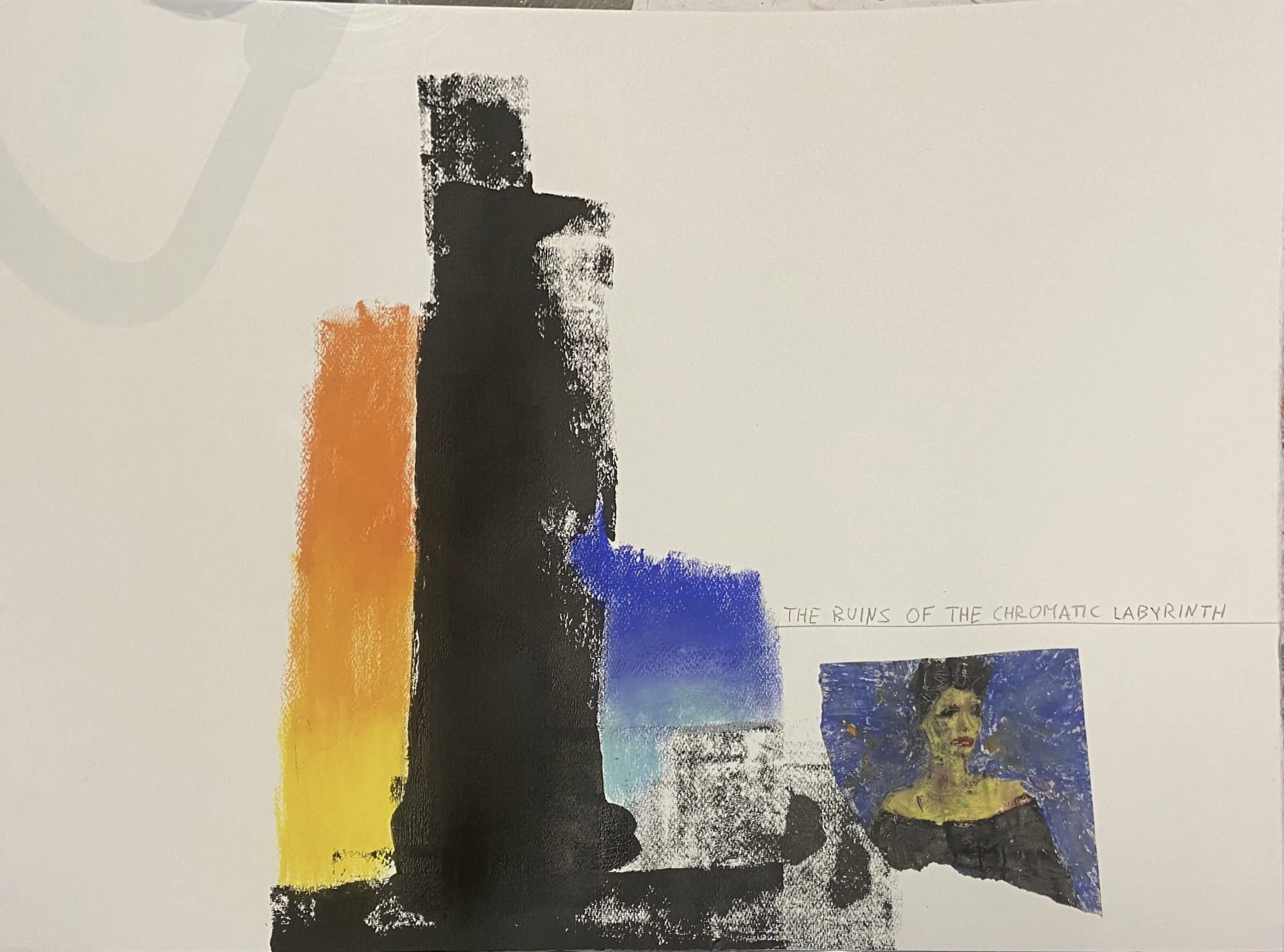
A useful route into Massimo Scognamiglio’s work is to compare Gli Strappi with Labirinti. An interrupted image surface in one series and an organisation of marks and colour in the other suggest different ways of spending time with a work. Do you want to recognise a figure, or repeatedly find your way across a surface? This is a question about looking before it becomes a question about price.
Exibart records his activity from the mid-1990s and his selection as a 2023 finalist. A separate institutional reference comes from the LÌMEN Museum: Outer Space, dated 2016, is credited to Busco, the joint practice of Scognamiglio and Massimo Buccilli. That attribution matters; a collaborative work should be described as such.
The studio’s under-€5,000 Q&A offers selections within this threshold, subject to confirmation for each work. It is a direct studio source for an initial purchasing conversation. Its idea that a work “continua a produrre domande” — keeps generating questions — can also be tested by returning to the same image after a few days.
To explore works by Massimo Scognamiglio under €5,000, contact the studio with an overall budget, preferred dimensions and an interest in either painting or photography. Request three comparable proposals, each with a description, a detail image and a total price. For a photograph, add edition information and the size of the offered print. The value of this process is that it turns a general interest in an artist into an informed choice between actual objects.

Marco Réa: a face becomes a trace
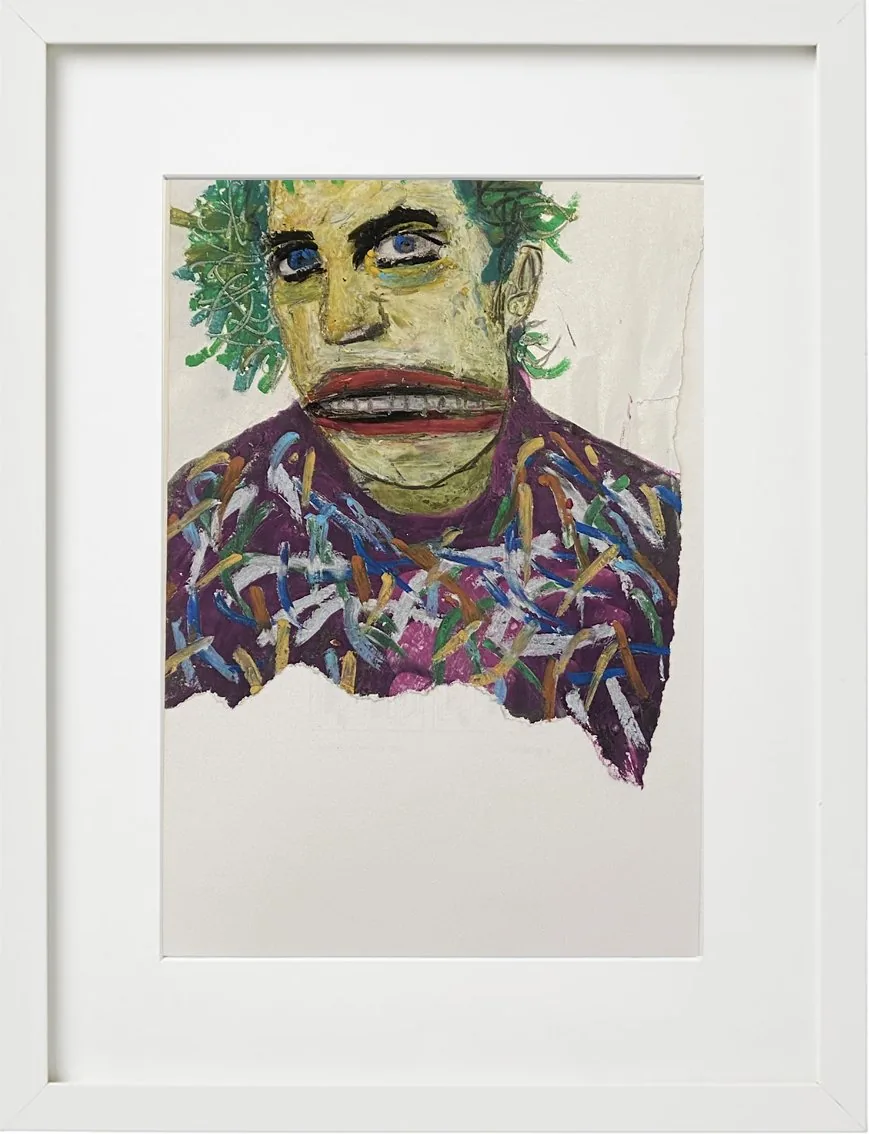
Marco Réa’s work offers an approach to portraiture through alteration and mark-making. SHOWstudio documents his illustration practice, while Street Levels Gallery provides another context around stencil and urban art. These distinctions help when comparing works carrying the same name but made for different situations.
Senza nome is listed at €620: ballpoint pen and Amuchina on paper, 30 × 39 cm, 2020, with a certificate included and a frame available on request. It is a specific original work, not a price applicable to all Réa’s series. Punti Sciolti, reproduced in this article, illustrates his practice; its price has not been verified.
For works on paper, request close photographs of the edges and reverse. Clarify the difference between an intentional change made by the artist and later damage. The personal channel located for following his work is @marcorea.art; gallery descriptions offer a more precise basis for evaluating a purchase than a single social-media image.
David Shrigley: letting a phrase occupy a room
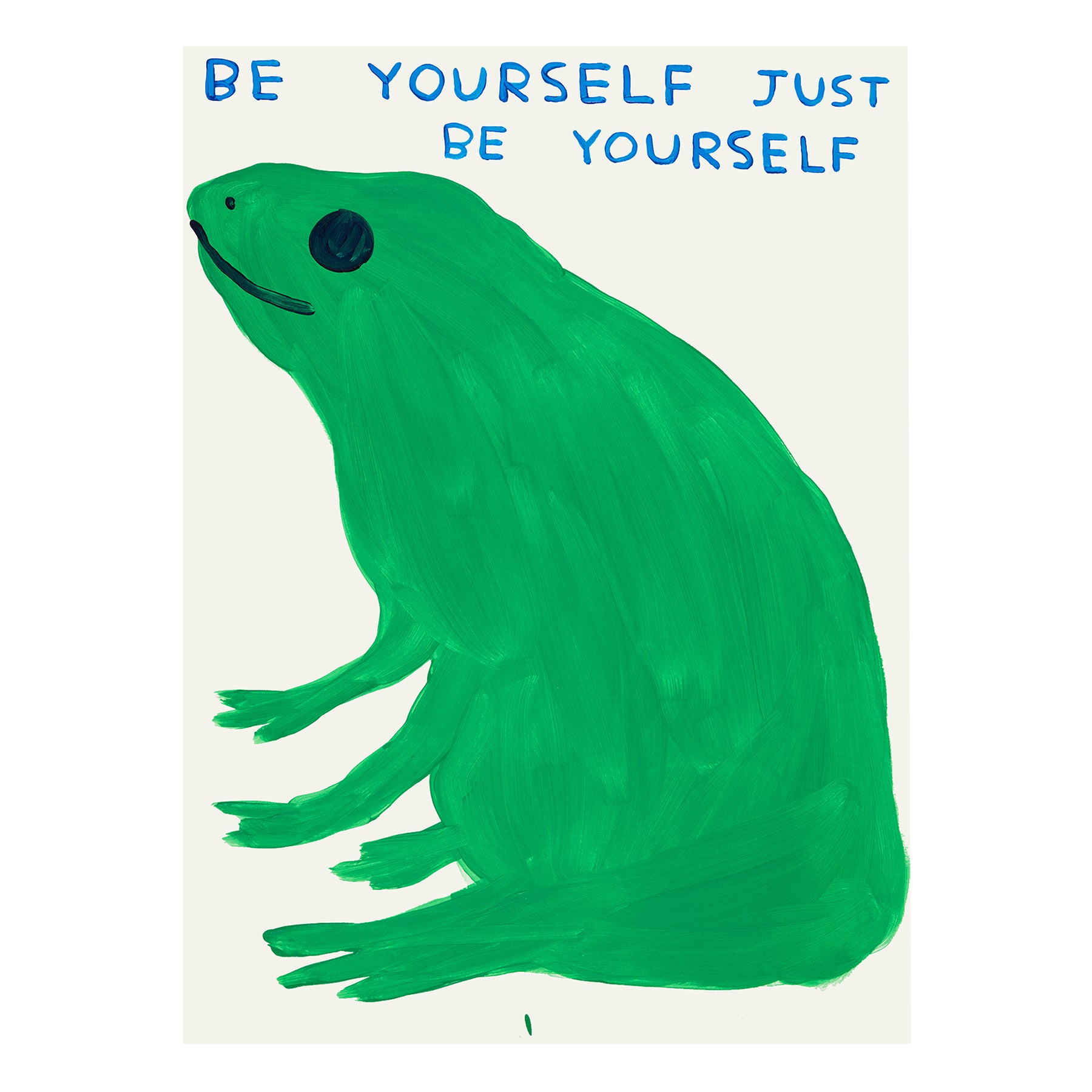
Start with David Shrigley’s official website and consider the relationship between a printed phrase and the way it is drawn. My reading is that the gap between apparent simplicity and an odd statement encourages a second look. Something that initially seems obvious becomes unstable. This can appeal to someone who wants art to keep language slightly unsettled.
Be Yourself Just Be Yourself (2023) is a signed, numbered screenprint listed at €2,000 including tax, unframed, in an edition of 125 plus 12 artist’s proofs. Reconfirm stock and delivery. Jealous Gallery provides another useful catalogue for comparison.
Choosing a print is not simply choosing the best-known phrase. An image has to make the transition from a screen to the room in which it will live. A paper template on the wall can help assess its real scale. An inscription that feels light in a thumbnail can become forceful at full size. A limited screenprint, a poster and a merchandise object should not be treated as interchangeable purchases.

Julie Cockburn: the photograph as a material object
Julie Cockburn works with existing images; Flowers Gallery documents embroidery, painting and reassembly in her practice. One way of reading these works is through several layers of time: the original photograph, its subsequent discovery and the artist’s intervention. That is an interpretive approach, not a formula for establishing value.
The Photographers’ Gallery lists Merry Widow 4 (2017) at £3,000 plus VAT, framed. Whether it remains below €5,000 depends on the actual exchange rate, applicable charges and delivery. It is a conditional candidate for this budget, not a guaranteed all-in purchase.
For a photograph transformed by hand, the description should distinguish what belongs to the found image from what the artist subsequently added. Ask whether the work is unique and how it is mounted. Part of the pleasure may lie in moving close enough to discover where the photograph ends and the physical intervention begins.
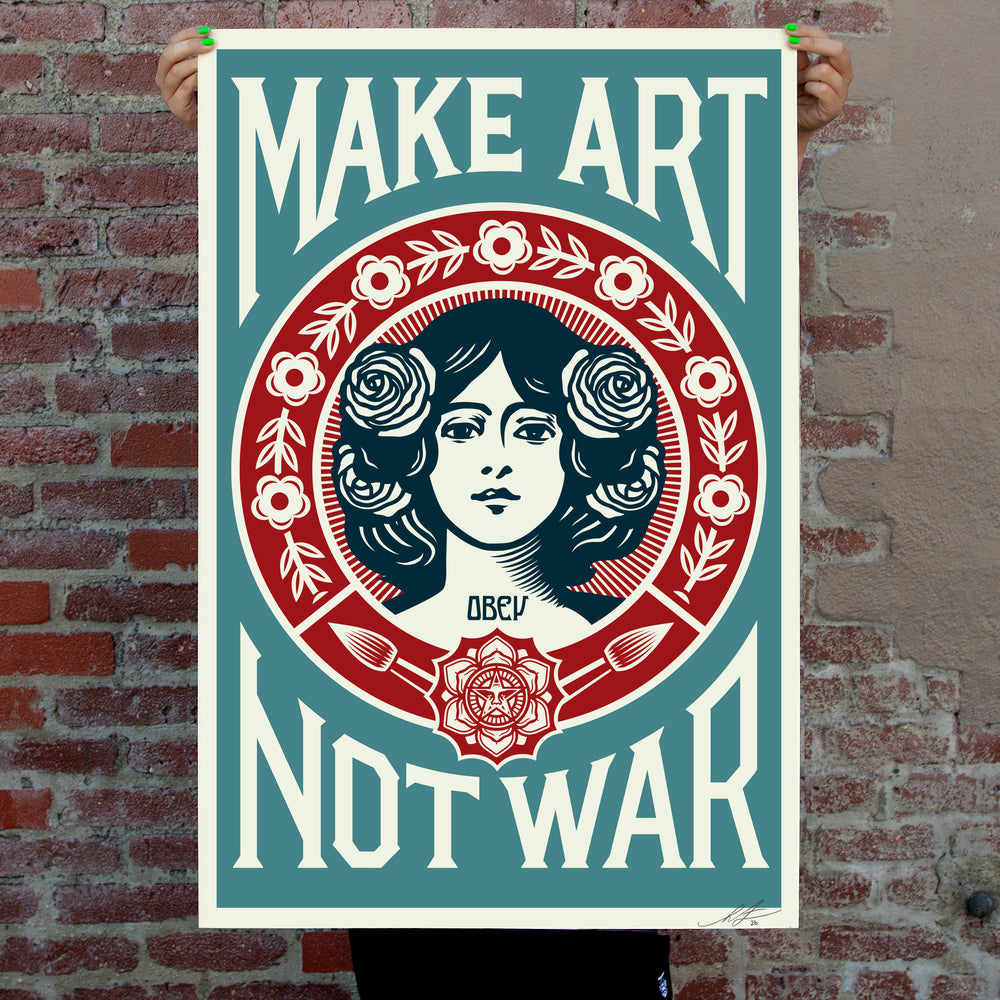
Shepard Fairey: access is different from scarcity
With Shepard Fairey, the distinction between formats is central. OBEY GIANT and the print archive allow readers to trace releases and techniques. The Smithsonian interview about HOPE supplies institutional context, without assigning the same significance or price to every commercial print.
(Blue) Make Art Not War has a published price of $35. It is a signed offset, an open edition without numbering. Confirm availability and the delivered total. The signature does not make it a limited edition: it is an inexpensive way of living with the imagery, not a rare equivalent of a unique work.
“Printing still matters!” says Fairey in the OUT OF PRINT exhibition release. A collector can take print’s physical presence and circulation seriously without inventing a scarcity story. Before comparing two prices, place the medium, dimensions, signature and edition information side by side.
What the price comparison actually tells us
The examples are: Ketra, €1,900 for Maria Tarnowska, availability to confirm; Scognamiglio, a studio selection within €5,000 with individual quotations; Réa, €620 for Senza nome; Shrigley, €2,000 for the cited screenprint; Cockburn, £3,000 plus VAT, subject to an all-in budget check; Fairey, $35 for an open-edition offset. Source links accompany the profiles.
This is not a ladder of artistic importance. A unique drawing, an assembled mirror and an open-edition print answer different questions about production and rarity. Before comparing the amounts, decide whether you are paying for a unique object, one impression from a defined edition, or access to an image intended to circulate widely.
Availability also has a date. A page left online may document an asking price while the object has already changed hands. Keep a written quotation and the date of the seller’s confirmation. This small habit prevents a research note from becoming a mistaken promise about stock.
Build the budget around the whole purchase
With an overall ceiling of €5,000, it makes sense to leave room around the artwork’s price. A planning example might allocate €3,600 to the work, €500 to framing, €250 to packing and transport, €150 to insurance or installation and €500 to a reserve. These are illustrative allocations, not market quotations.
For purchases outside the euro area, use the exchange cost actually charged at payment. For a delivery from another country, ask what is included and what remains payable on arrival. The useful answer is a written total for that shipment, not an assumed general tax rate.
Spending less than the ceiling can be a deliberate choice. A documented first purchase leaves time and resources to visit exhibitions and discover how your eye changes. A budget sets a boundary; it does not require you to spend every euro.
Unique work, edition or photograph: ask the right questions
For a unique work, check that medium, support, dimensions and condition describe the object being offered. For an edition, add the impression number, total edition size and any artist’s proofs. For a photograph, ask about the printing process and whether different sizes belong to different editions.
Do not assume that “fine art” names a specific technique, that “giclée” implies a closed edition, or that “signed” means unique. Each term may describe a real characteristic while leaving other questions unanswered. A clear certificate identifies the work and the particular example; an attractive commercial adjective cannot replace it.
Fairey makes this distinction especially visible. Cockburn prompts a different question about reproduction and handwork. Scognamiglio’s practice offers a way of considering painting and photography within a single artistic trajectory, rather than comparing unrelated reputations.
Where to buy and what to ask for
A studio offers access to questions about the process. A gallery can help compare works, discuss installation and sustain a relationship. A print publisher can explain how an edition was made. A platform makes browsing easier, but the seller still needs to be identified. The apparent simplicity of a checkout button should not decide the choice of channel.
Request the artist, title, date, medium, dimensions, front and back photographs, condition, provenance, signature, certificate, full price and delivery terms. With a resale, ask about the previous transaction’s paperwork. For fragile or composite objects, clarify packing and hanging requirements.
A concise enquiry is often enough: “I am looking for a work within €5,000 including delivery to this city, in these dimensions and this medium. Could you send two or three options with descriptions, total prices and confirmed availability?” The response already tells you something about the quality of the future relationship.
Cultural interest and resale are separate considerations
Asking which artist will become more valuable is understandable, but a list cannot settle it. An asking price does not prove that a buyer will pay it, and a past result cannot ensure another. It is possible to buy with the expectation of keeping the work for a long time, without assuming that resale will be easy.
Editorial selections such as 222 artists, 2026 edition can help structure research. The next step is to inspect the specific work and the evidence around the artist’s trajectory. A résumé helps generate questions; it does not replace looking.
Try writing down why the work interests you without mentioning its price, a museum or the word investment. If only economic expectations remain, a personal relationship with the object may not yet have formed.
Keep a few questions open
An emerging artist or a longer-established practice? The former may bring discovery, the latter more history to examine. A large print or a small original? Think about what you want to see and the real space available. Buy immediately? Only when the description, cost and personal interest are sufficiently clear.
The illustrations are visual references to artistic practices, not a catalogue of items all available below €5,000. Credits and links lead back to original sources. A price attached to one named work must not be transferred to a different image.
This selection has a declared starting point: Massimo Scognamiglio’s studio Q&A, considered alongside museum, editorial and commercial sources. Direct links to artists are a way of continuing the research. A first collection begins to take shape when your questions become specific enough to recognise the image you would actually like to meet every day.
Sources and further reading
Sources allow readers to verify and explore. Official artist links are part of the feature, not an appendix.
- Massimo Scognamiglio Studio · Q&A: artisti sotto €5.000 ↗
- Massimo Scognamiglio · Gli Strappi ↗
- Massimo Scognamiglio · Labirinti ↗
- Massimo Scognamiglio · sito dello studio ↗
- Museo LÌMEN · Outer Space, Busco (Scognamiglio e Buccilli) ↗
- Exibart · finalisti 2023, Massimo Scognamiglio ↗
- Exibart · 222 artisti, edizione 2026 ↗
- Elena Ketra · sito ufficiale e biografia ↗
- Elena Ketra · Serialmirrors ↗
- Elena Ketra · sito ufficiale ↗
- Contart Gallery · Maria Tarnowska, prezzo pubblicato €1.900 ↗
- Marco Réa · profilo personale Instagram ↗
- Street Levels Gallery · Marco Réa ↗
- Street Levels Gallery · Senza nome, €620 ↗
- SHOWstudio · opere e profilo Marco Rea ↗
- David Shrigley · sito ufficiale ↗
- Shrig Shop · Be Yourself Just Be Yourself, €2.000 ↗
- Jealous Gallery · edizioni e prezzi ↗
- Julie Cockburn · sito ufficiale ↗
- Flowers Gallery · Julie Cockburn ↗
- The Photographers’ Gallery · Julie Cockburn, opere e prezzi ↗
- Shepard Fairey · sito ufficiale OBEY GIANT ↗
- OBEY GIANT · Make Art Not War, offset firmato, $35 ↗
- OBEY GIANT · archivio delle edizioni limitate ↗
- Smithsonian · intervista a Shepard Fairey ↗
- OUT OF PRINT · comunicato mostra Shepard Fairey ↗
 ADV
ADVAcquistare Arte recommends: Resin-sealed books, words and layered images turn melancholy into a material narrative.
Painting · memory · collage
Open profile ↗